

Choosing the Right PES Membrane for High Purity Bioprocesses
You’re seeking a new process filter for your Bioprocessing system. After thoroughly researching and evaluating various options, you’ve identified the essential filtration requirements for your application. You’ve considered factors such as chemical compatibility, particle removal characteristics, bacteria retention ratings, flow rates, regulatory compliance, sterilization compatibility, and more. After reviewing filter data sheets, reading blogs on filter selection, and possibly consulting with potential vendors, you’ve determined that a polyether sulfone (PES) filter is the ideal choice for your system. However, you now face another crucial decision: which filter configuration is the most suitable for your specific needs?
Pore Size Selection
Pore size selection depends entirely on the specific purpose of filtration. For instance, if the objective is to remove bacteria and achieve a sterile filtrate, a filter rated for 0.22 microns or smaller, validated for sterile filtration, is necessary. On the other hand, if the goal is to eliminate mycoplasma, a tighter pore size, such as 0.1 microns or even 0.03 microns, is required. Additionally, if endotoxin removal is a concern, a positively charged filter with the selected pore size can provide both sterilization and endotoxin removal simultaneously.
For bioburden reduction, without necessarily aiming for sterilization, filters with pore sizes of 0.45 microns or 0.22 microns, validated for reduction (not necessarily requiring a 7-log reduction for sterilization), can be used. These filters are generally more cost-effective compared to the validated sterilizing filters.
When used in a clarifying or other prefiltration step, pore sizes up to 1 micron can often be employed. The appropriate choice depends on the knowledge of the targeted particle size and flow rate.
Configuration
Critical Process Filtration offers a variety of configurations to suit your filtration needs.
1. A single-layer PES membrane filter with the specified pore size.
2. A double-layer PES membrane with the same pore size in each layer.
3. A double-layer PES membrane with a larger pore size in front of the final filter.
These configurations can also be manufactured using positively charged membranes to remove endotoxins and other negatively charged particulates.
4. A double-layer filter with a high-capacity PES pre-filter in front of the final filter.
SPS, BPS, and SPC
A single-layer filter generally offers the highest flow rate per cartridge. This is often a satisfactory option for fluids with low bioburden, free of larger particulates, and other contaminants. SPS (sterilizing) or BPS (bio-reduction) filters can provide excellent flow rate and retention, along with an acceptable service life. These filters can also be equipped with a positively charged membrane (SPC) for endotoxin removal applications.
BPS filters can be supplied with an optional High-Capacity PES pre-filter built-in. This is an excellent choice when particulates and other contaminants might foul the final layer, thereby extending the useful life and reducing overall filtration costs.
PPS and PPC
For enhanced retention assurance, a double layer of the same filter (PPS) can be employed. While this configuration results in a lower flow rate, it provides additional assurance that the target organisms are effectively removed. This is also the preferred setup for positively charged endotoxin filters (PPC), as the two layers contribute to the overall charge capacity of the filter. However, the downside of this configuration is a reduced filtration area and a lower flow rate per cartridge. These limitations can be mitigated by using a larger (longer) filter or by incorporating multiple filters into a housing.
DPPS and DPPC
For fluids with high bioburden but low particulate contamination, a DPPS filter is an appropriate choice. This configuration employs a more open PES membrane in front of the final pore size filter to capture some of the bioburden load, thereby extending the overall filter life. For instance, a sterilizing grade 0.22 micron filter may necessitate a 0.45 or even 0.65 micron membrane pre-filter to safeguard the 0.22 micron filter from premature fouling.
Additionally, this configuration can be equipped with positively charged membranes to facilitate the removal of bacteria along with endotoxins.
HPPS
This configuration, similar to the BPS with optional prefilter described earlier, incorporates a High-Capacity PES membrane layer in front of the sterilizing grade PES membrane. This setup is particularly beneficial for removing particulate contaminants, thereby extending the life of the sterilizing filter.
Cartridges and Capsules
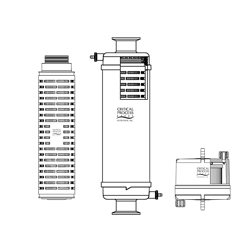 All the filters described above are available in both cartridge and capsule forms. Cartridges come in lengths ranging from 5 inches to 40 inches, providing flexibility in setting up a filter system to suit your flow requirements. Standard capsules are available in lengths from 2 inches to 30 inches and can be supplied pre-sterilized using gamma radiation. Additionally, all configurations are available in micro-capsule form for small-volume filtration, laboratory filtration, or small-volume qualification tests. All capsules are constructed from the same materials, enabling direct scaling up as needed.
Integrity Testing
All sterilizing and bioburden reduction filters are guaranteed to be 100% integral before they are released. This is usually achieved using forward flow air diffusion. We can also provide instructions and values for bubble point and pressure decay methods, as needed. The diffusion release values are validated against the bacteria removal performance, as required.
Sterilization
Cartridges can be equipped with a stainless steel support ring in the o-ring fitting, enabling steam-in-place and autoclave sterilization. Capsules can undergo multiple autoclaving cycles, provided they were not pre-sterilized using gamma radiation. Standard chemical sanitization methods are suitable for both cartridges and capsules.
Filter Quality and Materials of Construction
Critical Process Filtration methodically selects and controls the materials used in manufacturing bioprocessing filters to ensure compliance with applicable quality and regulatory standards. All materials employed at CPF are non-toxic and meet the stringent requirements of USP Class VI and MEM elution Cytotoxicity tests.
 Filters are meticulously designed to eliminate extractable substances that could potentially alter or contaminate the fluid being filtered. Extractables tests reveal that the filters possess minimal levels of non-volatile residues and Total organic carbon (TOC), posing no risk to the filtered fluid. Furthermore, CPF filters comply with Title 21 CFR sections 210.3 (b)(6) and 211.72, which pertain to non-fiber releasing filters.
Materials used at CPF adhere to the FDA’s established standards for items intended for repeated food contact, as outlined in Title 21 CFR sections 174.5, 177.1500, 177.1520, 177.1630, 177.2440, where applicable.
Support and Testing
If your process objectives and fluid characteristics (such as flow rate, batch size, particle size, and bacteria load, etc.) are well-defined, we can often provide a recommendation based on the information you provide. However, if there are gaps in information, a brief conference call with CPF Applications specialists can help narrow down the options and identify the best one. Additionally, our Applications Team can conduct filtration tests with your process fluid either in our Applications Lab or at your facility, if necessary.
Are you in need of Assistance in Specifying the Optimal Filter for Your Process?
Critical Process Filtration’s Applications and Process Support staff are here to help you choose the right filter for your application. If you’re looking for a replacement for a sterilizing filter, we can recommend an appropriate equivalent. Our team can conduct any necessary tests to identify the best filters for your process and help you determine the number of filters you need. We can also provide support in verifying and validating performance as required.
For more information, contact CustomerService@criticalprocess.com