

How to Choose the Best Sterilizing Filter for Your Application
Your process requires a sterile end product. To achieve this, you plan on installing a sterilizing filter. However, with numerous options available, how do you determine the best one?
Choosing the optimal sterilizing filter enables you to manage bioburden effectively and create a streamlined process. Key considerations include the sterilization level, the type of material, filter validation and the membrane area to enhance throughput and flow rate. Below, we outline additional significant factors that can aid in your decision-making. Critical Process Filtration sterilizing grade filters ensure a sterile effluent, providing assurance in your filtration process. Furthermore, the Critical Process Filtration Applications team is ready to offer support.
Critical Process Filtration meets the market’s demand for a high-quality products, services, support, and optimal lead times. The company’s products are distributed through multiple sales channels, all supported by the manufacturer’s quality assurance, testing, and customer support services. With over 25 years of experience, CPF has a strong record of shipping products faster than many well-known vendors and helping customers succeed in their businesses.
Factors to be Considered
Level of Sterilization
The first and most important factor is to consider what level of sterilization is required. Are you looking to remove bacteria only? Is mycoplasma removal required? Is endotoxin contamination a concern? The responses to these questions will determine the required pore size and type of filter for your specific application.
For mycoplasma removal, a smaller pore size is required - 0.1 or even 0.03 micron, depending on the manufacturer and validation testing.
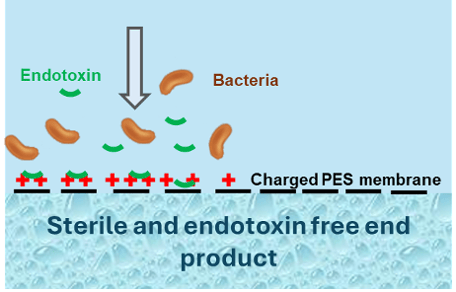
In cases where endotoxin removal is also required, a positively charged PES or nylon filters are needed, Figure 1.
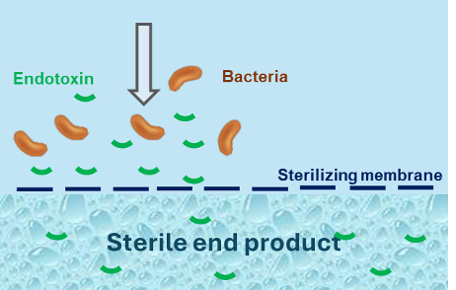
Effective removal of bacteria can be accomplished using sterilizing membrane filter sizes of 0.1, or 0.22 micron, as validated for bacteria retention, see Figure 2.
Sterilization of air, gases, and solvents can be accomplished by using PTFE filters.
Media Types
These are some key characteristics of the media to consider:
| Characteristics | Nylon | Positively Charged PES | PES | PTFE |
|
Aqueous Sterile Filtration |
Excellent | Excellent | Excellent | Pre-Wetting |
| Extractables | Extremely Low | Extremely Low | Extremely Low | Extremely Low |
| Hydrophobicity | No | No | No | Excellent |
| Regulatory | Yes | Yes | Yes | Yes |
| Sterilization Compatibility | Excellent | Excellent | Excellent | Excellent |
| Solvent Resistance | Yes | No | No | Excellent |
Validation of Sterilizing Filters
Validation is essential to confirm that the filters guarantee the sterility of the end product. Multiple studies are required to achieve comprehensive filter validation. This process would include analyzing extractables, conducting toxicity testing, assessing chemical compatibility, performing integrity testing, and conducting bacterial retention testing.
The filters should undergo a validation process that incorporates tests to ensure that the sterilizing filters do not release extractable materials when exposed to both water and drug product formulations.
Sterilizing filters must be validated using test procedures that comply with ASTM F 838-20 standards for determining bacterial retention in filters used for liquid filtration. The challenge level is a minimum of 107 organisms per cm2 of filter media. CPF filters demonstrate > 7-log removal when challenged with the organisms listed below (0.03 μm, 0.10 μm, and 0.22 μm meet the FDA’s definition of sterilizing grade filters)
| Pore Size | Organisms Used to Validate |
| 0.03 μm | Acholeplasma laidlawii |
| 0.10 μm | Brevundimonas diminuta |
| 0.22 μm | Brevundimonas diminuta |
| 0.45 μm | Serratia marcescens |
| 0.65 μm | Saccharomyces cerevisiae |
Log Removal Values (LRV) for a Single layer sterilizing membrane challenged to Brevundimonas diminuta:
| Pore Size | PES | Nylon | PTFE |
| 0.10 μm | > 8 | > 9 | > 10 |
| 0.22 μm | > 8 | > 8 | > 9 |
Throughput
The key factor influencing the performance of media filtration systems is the total throughput or filter capacity, which refers to the total volume of fluid that can be processed through a specific filtration area. When assessing filter performance, it is essential to consider additional factors such as temperature, differential pressure, and filter pretreatment.
Filter capacity or throughput measurement must be conducted using the drug product solution. The testing procedures should be specific to the application and may require various fluid types, particle types, concentrations, and flow conditions (including constant pressure versus constant flow, and single pass versus multipass). This testing can be executed on a small scale. Acceptable methods include Vmax SM testing, constant-flow trials, and flow decay trials.
A single layer filter will generally provide the highest flow rate per cartridge; however, depending on the fluid characteristics discussed above, it may lead to premature fouling and reduced service life. Incorporating a pre-filter membrane can function as a protective barrier upstream the final filter membrane. Initially, significant amounts of contaminants are removed before they can reach the final filter membrane. This process is similar to using a pre-filter in front of a final filter cartridge; however, in this scenario, the pre-filter membrane is integrated within the filter cartridge element as part of a heterogeneous double layer construct. This configuration also eliminates the necessity for two separate filter housings. It is important to note that the pre-filter layer in a heterogeneous filter design contributes to increased flow resistance, resulting in a lower flow rate compared to its single layer equivalent. Yet, it is still higher than that of a homogeneous (0.2/0.2 µm) filter cartridge.
Incorporating an integrated pre-filter will reduce flow rate per cartridge; however, this may be beneficial if it prolongs the service life to meet batch size requirements. The reduced flow can also be offset by using a longer cartridge or capsule - 20” or 30” instead of a standard 10” - or multiple cartridges in the same housing.
The quantity of filter elements and the dimensions of the required housing are determined by the necessary process flow rate.
For the endotoxin removal, Figure 3 illustrates the performance of CPF charged PES membranes and competitors when they are challenged to 106 pg/ml of purified Escherichia coli (Type 0113:H10 LPS) endotoxins to evaluate the maximum Log Removal Value higher (LRV). The CPF double layer charged PES membrane achieves an LRV higher than 5 at the longest throughput. CPF positively charged PES has the highest binding capacity in the market.
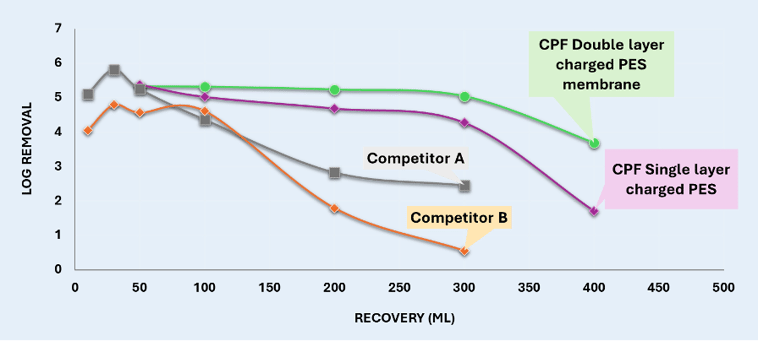
Figure 3: Throughput when charged membranes are challenged to 106 pg/ml of purified Escherichia coli (Type 0113:H10 LPS) endotoxins.
The following provides a qualitative difference among the options for sterilizing filtration. Each option is validated for bacteria removal (0.22 and 0.1 microns), mycoplasma reduction (0.1 microns), and mycoplasma removal (0.03 microns).
SPS Filters
- Single-layer PES sterilizing grade membrane filters
- Increased flow rate
PPS Filters
- Double-layer PES sterilizing grade membrane filter (same pore size)
- Ensure maximum bacteria retention and durability in critical applications
DPPS Filters
- Double-layer PES membrane filter with a bioburden reduction membrane in front of the sterilizing layer
- Remove high bacteria load streams to optimize life of the final filter
HPPS Filters
- Double-layer PES membrane filter with a high capacity prefilter in front of the sterilizing layer
- Use for high particulate load streams to protect the final sterilizing filter
PPC Filters
- Double-layer positively charged PES
- Use for endotoxin removal
PNC Filters
- Positively charged Nylon 6,6
- Use for endotoxin removal where PES compatibility is an issue
PNM Filters
- Sterilizing grade nylon membrane
- Use for chemical compatibility where PES might be a concern
PTR Filters
- Sterilizing grade PTFE optimized for high air flow
- Use in tank vent and process gas filtration
PTM Filters
- Sterilizing grade PTFE
- Primarily used as vent filters and non-aqueous liquids
Fluid Characteristics
Once the required pore size rating and filter type have been determined, it is essential to consider certain fluid characteristics to select the best filtration solution.
The chemical composition of your process fluid may limit the choice of membrane materials. For aqueous solutions, Polyethersulfone is usually the best option due to its high flow rate and dirt-holding capacity. In contrast, for other fluids that may negatively affect PES, a Nylon 6,6 membrane would be an appropriate alternative.
Process fluids include both the feed stream and agents used for flushing, cleaning, sanitizing, and depyrogenating. The membrane’s retention must stay reliable during device use, while its selectivity should remain steady during the operational phase. Please refer to the chemical compatibility of filter materials Chemical Compatability.
If the risk of endotoxin contamination is minimal, a positively charged sterilizing filter is adequate. In cases of high loads, using distinct sterilizing and endotoxin removal filters allows for the replacement of only the endotoxin filter as its charge diminishes.
If the fluid has low particulate contamination and has a relatively low bacteria count, a single layer membrane filter is likely to be sufficient. In critical applications, opting for a double layer of the same pore size rating could be a better choice.
For fluids with low particulates but higher bacteria count, a dual layer membrane filter with a larger pore size up front (for example 0.45 µm followed by 0.22 µm) can help prolong the life of the sterilizing layer.
In cases where the fluid has a significant particulate load, a higher capacity pre-filter can be incorporated before the final sterilizing layer.
The table below provides some examples of membrane filter configuration per application.
| Filter | Configuration | Rating | Application |
|
PPS Filters |
0.03 - 1.2 µm double layer sterilizing grade PES membrane (same pore size) |
Sterilizing |
Parenteral, cell culture media, buffers, serum, vaccines, biologics, and water for injection systems |
|
DPPS Filters |
Prefilter PES pore sizes: 0.1 to 1.2 µm. Final layer PES pore sizes: 0.03 to 0.65 µm |
Bioburden/ Sterilizing |
SVPs & LVPs, cell culture media, serum, vaccines, biologics, water purification and water for injection systems |
|
HPPS Filters |
Double layer: Prefilter and asymmetric filter. 0.2/0.1, 0.5/0.2, 0.8/0.22 µm | Sterilization fluids with high particle loads | Cell culture media, serum, vaccines, biologics, and buffers |
|
PPC Filters |
Double layer PES positively charged 0.03, 0.1, 0.22, 0.45 µm | Sterilization & Endotoxin removal | Process water and water for injection systems |
|
PTR Filters |
PTFE 0.22 µm | Sterilization of process gas applications and tank vents | Tank vents, compressed air, pressurized gases, and fermentation air |
For more detailed information regarding sterilizing filters, please refer to the Buying Guide to Bio-Pharmaceutical Filters.
Endotoxin
Must comply with the USP standards for the Bacterial Endotoxins Test using an aliquot from a soak solution that has a concentration of < 0.25 EU/ml, as determined by the Limulus Amebocyte Lysate test. CPF sterilizing filters are below this limit as specified for water for injection.
Integrity Testing & Pre-sterilization
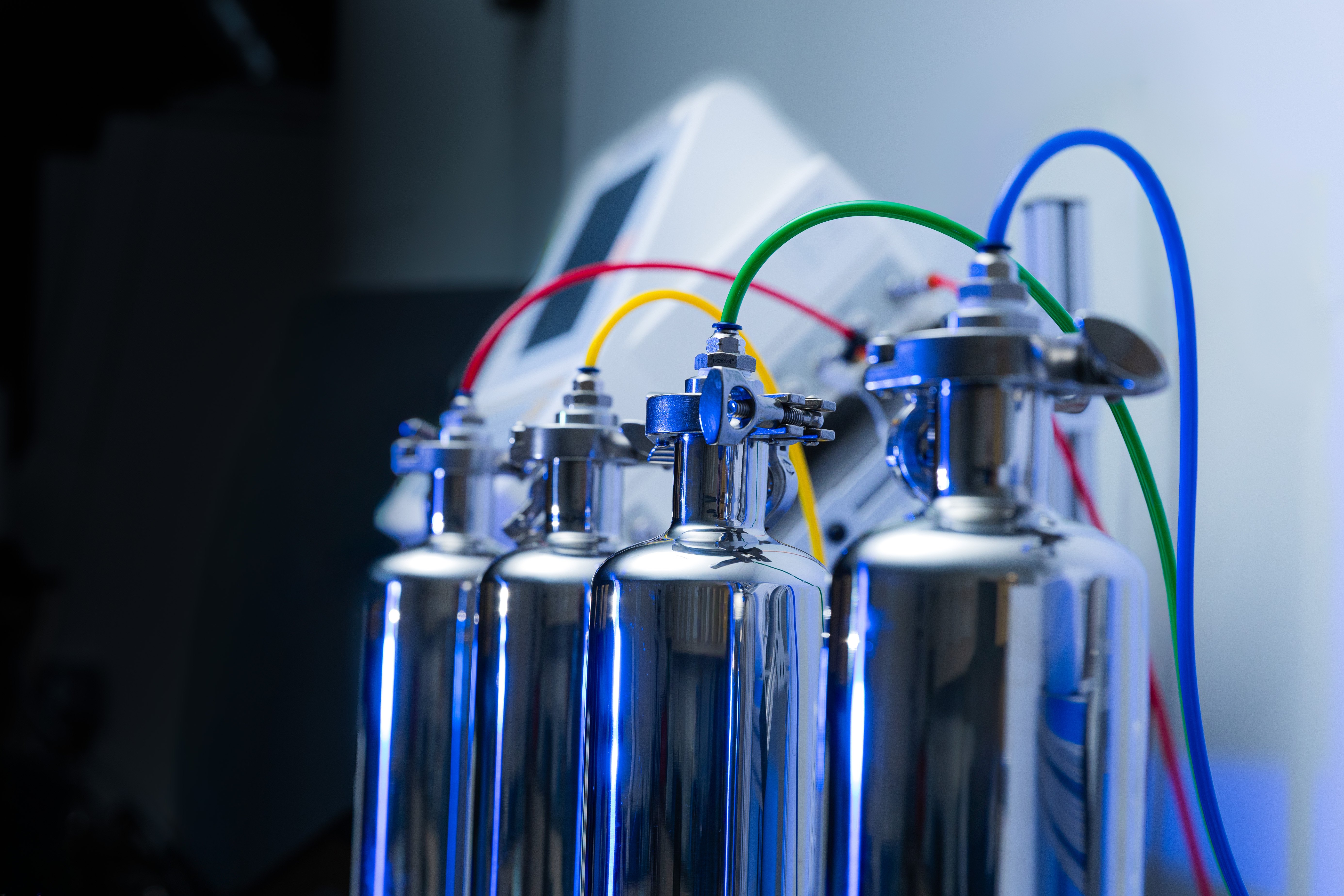
All sterilizing filters must be integrity tested before they are released. CPF filters are 100% integrity tested, see Figure 4 for an example of an integrity testing setup. Integrity tests such as bubble point, diffusion, or water-pressure methods, are used. These tests will confirm the reliability of the membrane filter, its absolute pore size, and its rejection characteristics.
Furthermore, the criteria for integrity test release must be correlated to a bacteria and/or mycoplasma challenge test, typically following ASTM F838 protocols as mentioned above. The correlation between a non-destructive integrity test and the assurance of bacterial retention constitutes a filter validation study, which is crucial for microbial retentive filters utilized in essential fluid processes.
In some cases, it may be desirable to purchase pre-sterilized filters. This approach removes the necessity of sterilizing the filters post-installation. This is generally applicable to capsule filters, which maintain sterility after being opened as long as they are handled and installed correctly. Conversely, cartridge filters are not normally supplied pre-sterilized, as opening the packaging (usually plastic bagging) will most likely compromise the sterilization, regardless of how carefully the cartridges are handled.
There are several methods employed to pre-sterilize filters, with gamma radiation after packaging being the most established.
If the filter is intended to undergo steam sterilization prior to use, it is essential to validate the filter's integrity following the sterilization process. The pre-use integrity test should be conducted after steam sterilization or autoclaving to confirm integrity immediately before product filtration.
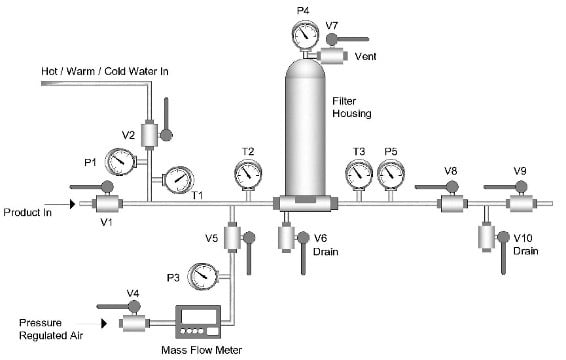
Figure 4: Integrity Test System
Filter Quality & Materials of Construction
Materials used to manufacture sterilizing filters must be carefully selected and controlled to ensure compliance with applicable quality and regulatory standards. All materials used at Critical Process Filtration are non-toxic and meet USP Class VI and MEM elution Cytotoxicity test requirements.
The filters must be free from extractable substances that could potentially alter or contaminate the fluid being filtered. This includes proper selection of raw materials, manufacturing equipment, and area cleanliness to protect the filters from the surrounding environment. CPF filters’ extractables tests indicated that the filters have minimal levels of non-volatile residues and Total organic carbon (TOC), which do not present any risk.
Sterilizing-grade filters must not release fibers, as specified in 21CFR 210.3(b)(6). The sterile filtration process is the final step in drug manufacturing, and any contaminants introduced to the product cannot be removed by any subsequent unit operation.
Materials used at CPF comply with the standards established by the FDA for items designed for repeated food contact, as specified in Title 21 CFR sections 174.5, 177.1500, 177.1520, 177.1630, 177.2440, where applicable.
Vendor Specialization
There are numerous sterilizing filters available in the market today. Their design can differ based on the materials used, manufacturing processes, country of origin, quality, pore sizes, and type and size of the device.
You can purchase sterilizing filters through various sales channels – directly from manufacturers, through distributors, on procurement sites, and from catalog houses.
Prices can vary significantly, with the most expensive options typically offered by large manufacturers that incur high R&D costs, while the least expensive options are often provided by high-volume, offshore manufacturers that may lack support and frequently exhibit product inconsistency. Critical Process Filtration is a vendor that provides highest quality, proven, reliable filters and technical support to all its customers.
Lead times can also vary widely. While every buyer desires product delivery that aligns with their production schedule, prioritizing the right product and quality is essential to prevent costly errors in your production environment. Therefore, when you identify the right product, why wait longer than necessary?
Support & Testing
You have identified your filtration goals and gathered information about the fluid(s) that need to be filtered. How do you decide among the options available? This is where Critical Process Filtration can assist you. Unlike other vendors, CPF manufactures all of the variations described above, allowing us to recommend the sterilizing filter that is best for your application, rather than merely recommending one that we happen to offer.
If your process objectives and fluid characteristics (such as flow rate, batch size, particle, and bacteria load, etc.), are well defined, we can frequently provide a recommendation based on the information you provide. In cases where there are gaps in information, a short conference call with CPF Applications specialists can narrow down the options and identify the best one. If necessary, our Applications Team is also capable of conducting filtration tests with your process fluid, either in our Applications Lab or at your facility.
Typical Example of Why Filtration Support Matters
A customer was using a sterilizing filter in their process but was experiencing premature fouling, preventing the completion of a batch without having to change and re-sterilize their filter train. They did not wish to invest in new equipment and plumbing to increase the size of their filtration system and were looking for alternatives. Following a discussion between the customer’s operations team and CPF Applications, the customer submitted a sample of their process fluid for filterability testing, along with a clogged filter for analysis.
Microscopic examination of the membrane from the clogged filter revealed the presence of a crystalline particulate as the cause of the issue. Laboratory scale testing with potential prefilter options indicated that placing a 0.5-micron high-capacity PES prefilter in front of the 0.22-micron sterilizing filter could extend the life of the filter by approximately three times. This was more than sufficient to meet their objective of processing a full batch without needing to change filters. Consequently, the customer acquired and installed HPPS-05-02 filters (0.5-micron prefilter over 0.22-micron sterilizing filter).
Are You in Need of Assistance in Sterilizing Filter Selection?
The Applications and Process Support staff at Critical Process Filtration's are ready to assist you in selecting the best filter for your application. If you are looking for a replacement for a sterilizing filter, we can suggest an appropriate equivalent. Our team can perform any necessary testing to identify the appropriate filters for your process, and we can assist you in determining the number of filters needed for your specific application. Additionally, we can provide support in the verification and validation of performance as required.