

Pressure Decay Testing: Why, When, and How?
Ensuring Integrity of Your Filters
To ensure the integrity of your filters, it is crucial to conduct tests before and after operation. For hydrophilic filters, there are several methods available:
- Forward Flow Air Diffusion: This method involves thoroughly wetting the filters with water (or other suitable fluid). Subsequently, the system needs to be pressurize on the upstream side (air or nitrogen) to approximately 70-80% of the membrane bubble point (the exact percentage varies from manufacturer to manufacturer). The air flow diffusing through the filter is then measured while maintaining the upstream pressure. This process requires an accurate mass flow meter or the use of an automated integrity tester. The diffusive flow value specifications have been validated to correlate with specific performance criteria, such as bacteria retention.
- Bubble Point: This method involves thoroughly wetting the filters with water (or other suitable fluid). Then, gradually increasing air pressure on the upstream side until bulk gas flow is observed. This can be done visually, measuring air flow versus pressure to an inflection point (the curve transitions from a shallow linear line to a steeper vertical line), or by utilizing an automated integrity tester. The bubble point value, which correlates with the largest pore in the membrane surface, has been validated to ensure that devices meeting the bubble point specification perform as required.
A Budget-Friendly Alternative
Both of these methods necessitate the use of costly equipment, such as a mass flow meter or an automated integrity tester, and a more intricate system installation if the test is to be conducted with filter in place. A budget-friendly approach is pressure decay testing.
- Pressure decay testing: This test operates on the same principles as the forward flow air diffusion test, but it can be performed without the need for expensive instrumentation. It only requires a pressurized gas source and an accurate pressure gauge.
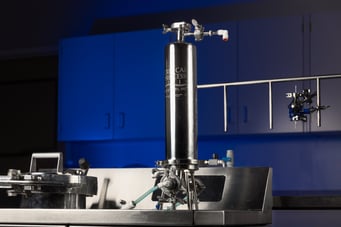
Forward flow air diffusion measures the flow of a gas as it diffuses through a wetted membrane at a sustained pressure below the bubble point. It quantifies the gas flow required to maintain the test pressure on the upstream side as it traverses the membrane.
Conversely, the pressure decay test ascertains the pressure loss incurred due to this diffusion over a specified time duration. As air transitions from the upstream side to the downstream side, the upstream pressure will decrease in proportion to the upstream volume and the rate of air flow.
Setting Up for Pressure Decay Testing
A typical setup for conducting a pressure decay test is depicted in Figure 1 (cartridge housed within a housing) and Figure 2 (Capsule). To ascertain the acceptable pressure loss, it is imperative to determine the upstream volume of the filter housing and lines after the air shutoff valve (V1).
Either of these configurations could be easily set up to operate on the filter without the need to remove it from the line. This is particularly crucial when conducting pre-use integrity checks after sanitization and/or post-use integrity checks to ensure that no alterations have occurred.
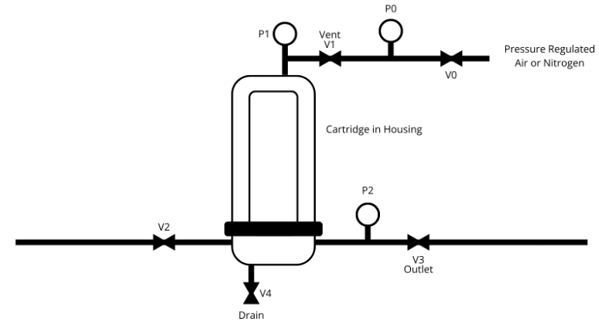
Figure 1: Cartridge Pressure Decay Test Attachment to Housing Vent

Figure 2: Capsule Pressure Decay Testing
Calculating the Pressure Decay Limit (DP)
Once the upstream volume is determined, the pressure decay limit (DP in the equations below) can be calculated from the following equation:.
Equation 1 - Pressure Hold Test Formula:
(D) x (T) x (Pa) = (DP) x (Vh)
Rearranging this equation gives:
DP = (D) x (T) x (Pa) / (Vh)
Where:
D = Diffusion rate cc/min (max value from the product data sheet)
T = Time (minutes)
Pa = Atmospheric Pressure (14.7 psi)
DP = Pressure Drop (psi)
Vh = Upstream volume of apparatus (cc)
For help determining the test values or additional information, contact customerservice@criticalprocess.com or call us at (603) 880-4420.
For more information on Pressure Decay Testing, see:
Capsule Pressure Decay Testing
Cartridge Pressure Decay Testing