

Nominal vs. Absolute Pore Size Rating - What's the Difference?
Nominal vs Absolute
One of the key features of any filter is its pore size rating, which informs the user about the particle size it can effectively remove. However, there are certain aspects of the pore size rating that need to be carefully considered. Filter manufacturers typically specify pore size ratings as either Absolute or Nominal.
In general, a Nominal rating indicates the approximate particle size that the filter can capture, while an Absolute rating indicates the largest particle that can pass through the filter.
Most membrane filters are classified as Absolute rated. This means that the filter effectively removes virtually all particles above the rated pore size. The percent removal for these types of filters is usually 99.999% or higher. These filters can be validated to ensure consistent retention and are generally used in critical applications such as sterile filtration in pharmaceutical applications, removing yeast and mold from beverages, and particle removal in electronics water filtration.
Understanding the Beta Ratio
Some vendors rate depth filters as Absolute, but it’s crucial to understand their definition. Depth filters are often categorized by Beta Ratio (β-ratio), which is the concentration of particles in the feed divided by the concentration of particles in the filtrate. For instance, a 90% efficient filter has a β-ratio of 10 (100 particles in ÷ 10 particles out). 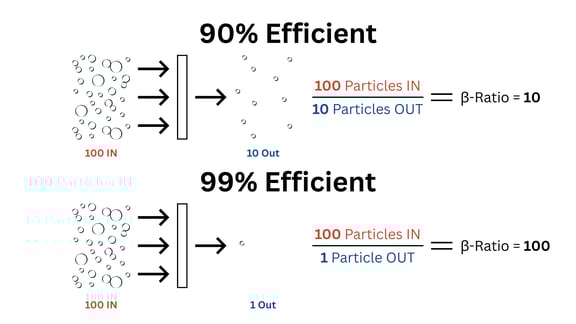 A 99% efficient filter is classified as β-100 (100 particles in ÷ 1 particle out), and so on. To be rated as Absolute, these filters typically have a removal efficiency in the range of 99.9 to 99.98 (β-1000 to 5000). These filters are highly effective in particulate removal and are used in clarification and prefiltration where more expensive Absolute-rated membrane filters might be excessive. However, they are not usually validated for critical applications, as mentioned earlier. It’s essential for users to consider the removal rating when determining the suitability of a filter for a specific application.
When considering using a Nominal-rated filter, it’s crucial to understand that the removal rating can vary significantly between manufacturers or even between different filter types from the same manufacturer. Some Nominal filters have a low removal rating, ranging from 60% to 80% efficiency (β-5 or less). These filters are typically used as the initial filtration step in processes that contain a lot of larger debris that needs to be removed to prevent clogging of more critical filters further down the line. On the other hand, Nominal-rated filters with a removal rating of 90% or higher (β-10 to 100+) are widely used as prefilters in front of critical final filters. For instance, a 0.5 or 0.2 micron Nominal filter rated at β-100 (99%) will usually provide excellent protection for a 0.22 micron absolute filter. The specific filter combination required will depend on the process in question.
De-rating of Absolute Filters
It’s also worth noting that some filter manufacturers may “de-rate” an Absolute filter by using a Nominal filter. For instance:
A customer might not necessarily need a validated retention rate but insists on a 0.2 micron filter. However, testing an Absolute-rated 0.2 micron filter may result in a flow rate that’s less than required or clogging that’s faster than desired. In such cases, some suppliers might offer an 0.45 (or even 0.65) micron Absolute filter labeled as an 0.2 micron Nominal.
Factors to Consider
In summary, when searching for a process filter, it’s crucial to know the pore size rating required. However, it’s almost equally important to consider the accompanying factors:
- Absolute versus Nominal.
- Retention Rating, which can be either expressed as a percentage of particle size removal or a β-ratio.
- Whether the filter needs to be validated to a specific removal level.
Critical Process Filtration offers a diverse range of filter materials and configurations, catering to both Absolute and Nominal ratings. Our Applications Engineers are dedicated to assisting you in streamlining your selection process, ensuring that you obtain the appropriate filter at an economical price. For further information, please don’t hesitate to reach out to us at customerservice@criticalprocess.com.