

Why Polymeric Membranes Fail in High Purity Filtration
Polymeric membrane filters are used across pharmaceutical, biotech, and electronics manufacturing to remove particles, bacteria, and other contaminants from process fluids. When these filters fall short of expected performance, the root cause often traces back to fouling, chemical incompatibility, or contamination from the filter itself.
This article walks through the primary failure modes of polymeric filtration membranes in high-purity applications. You will learn how fouling develops, where chemical compatibility breaks down, and what extractables and leachables mean for your product. Critical Process Filtration helps manufacturing teams identify the right filter media and configuration for their specific process conditions.
Key Takeaways: Why Polymeric Membranes Fail in High Purity Filtration
- Fouling is the most common reason polymeric membrane filters lose flow capacity and require premature replacement in high-purity processes.
- Chemical incompatibility between your process fluid and the membrane polymer can degrade the filter and release contaminants downstream.
- Extractables and leachables from polymeric membranes can pose a risk to pharmaceutical product purity and regulatory compliance.
- Critical Process Filtration offers testing and analytical services to help you match filter media to your process stream.
- Selecting the correct membrane material, pore size rating, and prefiltration strategy reduces unplanned filter changes and protects product quality.
What Is Membrane Fouling in High-Purity Filtration?
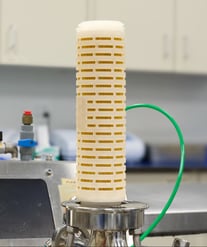 Membrane fouling occurs when particles, proteins, or other solutes accumulate on or inside the pore structure of a polymeric filter. Some operators refer to this as "clogging" or "plugging," but the technical term is fouling. It reduces flow rate and increases pressure drop across the filter element.
In biopharma processing, fouling is particularly common during sterile filtration of protein-rich solutions. Proteins adsorb onto the membrane surface and form a secondary layer that restricts flow. The rate at which this happens depends on protein concentration, solution pH, ionic strength, and the level of hydrophobic interaction with the filter
According to a 2025 review published in Advanced Membranes, fouling remains one of the primary limiting factors for sterilization and virus filtration membranes in biopharmaceutical manufacturing. The review identifies protein adsorption as a key driver of flow decay.
How Does Fouling Affect Filter Life and Process Efficiency?
When a membrane fouls prematurely, you face shorter filter life, more frequent changeouts, and higher operating costs. Each unplanned filter replacement interrupts production and adds to your total cost of filtration.
The degree of fouling depends on several process-specific variables. Fluid composition, temperature, flow rate, and particle size distribution all influence how quickly a membrane reaches its capacity. A filter rated at 0.2 micron may foul at very different rates depending on the upstream particle load.
This is why premature fouling is often a system design issue rather than a filter defect. The membrane is doing its job by capturing contaminants. If the contaminant load exceeds what the filter was sized to handle, fouling accelerates.
What Role Does Chemical Compatibility Play in Membrane Failure?
Every polymeric membrane material has specific chemical compatibility limits. PES (polyethersulfone), PVDF (polyvinylidene fluoride), nylon 6,6, and blended cellulose each respond differently to solvents, acids, bases, and sanitization chemicals.
If your process fluid or cleaning agent falls outside the membrane material's compatibility range, the polymer can swell, soften, or degrade. This degradation compromises pore structure, reduces removal efficiency, and may release polymer fragments into the filtrate.
A common example is the use of strong oxidizing agents with PES membranes. PES has limited tolerance for sodium hypochlorite at elevated concentrations. PVDF membranes, by contrast, tolerate a broader range of aggressive chemicals but have their own limitations with certain ketones and esters.
Extractables and Leachables: A Contamination Risk
Extractables are chemical compounds that can be pulled from filter materials under exaggerated laboratory conditions. Leachables are the subset of those compounds that migrate into your actual process fluid under normal operating conditions.
For pharmaceutical and biotech manufacturers, leachables from polymeric membrane filters are a regulatory concern. The FDA's ICH Q3E guideline addresses extractables and leachables from manufacturing components, including filters, that contact drug products.
The risk varies by membrane material. Some polymers release plasticizers, antioxidants, or processing aids that can interact with active pharmaceutical ingredients. Evaluating this risk requires leachables testing under conditions that represent your specific process, including temperature, contact time, and solvent strength.
Why Pore Size Rating Alone Does Not Predict Performance
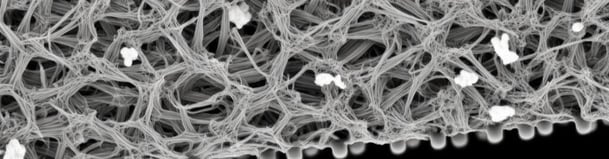
Two filters with the same pore size rating can perform very differently in the same application. This happens because pore size is only one of several factors that determine filtration performance. Removal efficiency, membrane structure (asymmetric versus symmetric), and dirt-holding capacity also shape how a filter behaves in your process.
If you replace a filter based on pore size alone without confirming the efficiency rating, you may see a measurable change in downstream product quality.
This is where a filterability analysis adds value. By testing your actual process fluid against candidate filter media, you get data specific to your conditions rather than relying on generic specifications.
How Prefiltration Reduces Polymeric Membrane Failures
One of the most effective strategies for extending membrane filter life is adding a prefiltration step upstream. A prefilter captures the larger particles and colloidal material that would otherwise reach your final membrane and accelerate fouling.
The correct prefilter pore size depends on the particle size distribution in your process stream. If you select a prefilter that is too open, it will not reduce the contaminant load reaching the membrane. If it is too tight, the prefilter itself fouls quickly and adds unnecessary cost.
Critical Process Filtration's Application Engineers work with your team to design prefiltration trains that balance particle removal with filter life. CPF's dual-layer cartridge filters combine a depth media prefilter with a membrane final filter in a single housing, reducing the number of filter changes and simplifying your filtration operation.
How to Evaluate Filter Media for Your High-Purity Process
Selecting the right membrane material starts with understanding the variables in your process: fluid composition, operating temperature, chemical exposure during cleaning, target removal level, and required flow rate.
A structured evaluation approach includes these steps:
- Identify the contaminants you need to remove and the required pore size rating
- Confirm membrane chemical compatibility with your process fluid and cleaning agents
- Run a filterability analysis with your actual fluid to measure dirt-holding capacity
- Perform integrity testing to verify filter performance before and after use
- Assess extractables data to confirm regulatory compliance
- Determine the appropriate filter size for the application
Critical Process Filtration's verification and validation services test your process stream on CPF filter products, confirming that the filter meets your performance goals and regulatory requirements.
Matching the Right Filter to Your Process Conditions
Polymeric membrane failures in high-purity filtration are not random events. They follow predictable patterns rooted in fouling mechanisms, chemical compatibility limits, and extractables risk. The path to more reliable filtration starts with understanding these variables and matching them to the correct filter media and system design.
If you are experiencing premature fouling, unexpected pressure drop, or concerns about extractables in your process, CPF's technical support team can help you investigate the cause and identify the right filtration solution for your specific conditions.
FAQs About Why Polymeric Membranes Fail in High Purity Filtration
What is the most common cause of polymeric membrane failure?
Fouling is the most frequent cause. Particles and proteins accumulate on the membrane surface or inside pores, restricting flow and raising pressure drop. The rate of fouling depends on your fluid composition, particle load, and operating conditions.
How do leachables from filters affect pharmaceutical products?
Leachables are compounds that can migrate from filter materials into your process fluid. In pharmaceutical manufacturing, these compounds may interact with active ingredients or raise regulatory concerns.
Can chemical incompatibility damage a polymeric membrane?
Yes. Exposing a membrane to a solvent or cleaning agent outside its compatibility range can degrade the polymer structure. This may reduce removal efficiency and release polymer fragments downstream. Always verify chemical compatibility before selecting a filter.
How does prefiltration help extend membrane filter life?
A prefilter captures larger particles before they reach your final membrane, reducing the contaminant load and slowing fouling. Critical Process Filtration's dual-layer cartridge filters combine prefiltration and final filtration in one unit, extending filter life and lowering changeout frequency.
Why do two filters with the same pore size perform differently?
Pore size is only one performance factor. Removal efficiency, membrane structure, and dirt-holding capacity also determine how a filter performs. Critical Process Filtration's filterability analysis tests your actual fluid against candidate media to identify the right match for your process.